A clear understanding leads to better decisions.
Property damage and building performance concerns can have more than one possible explanation. An organized factual overview helps an investigation team understand the questions, identify useful evidence, and define an appropriate scope.
This guide outlines what to gather before reaching out and how an engineering investigation may proceed. The work depends on the property, access, available information, and the questions at issue.
Start with what happened.
Describe the property, the type of structure, and the specific damage or performance concern. Record when it was first noticed, who observed it, and whether conditions have changed.
Build a simple timeline of relevant weather, nearby construction, changes in use, and maintenance or repair work. Distinguish a confirmed date from an estimate or someone’s recollection. An event occurring near the time damage was discovered does not, by itself, establish a connection.
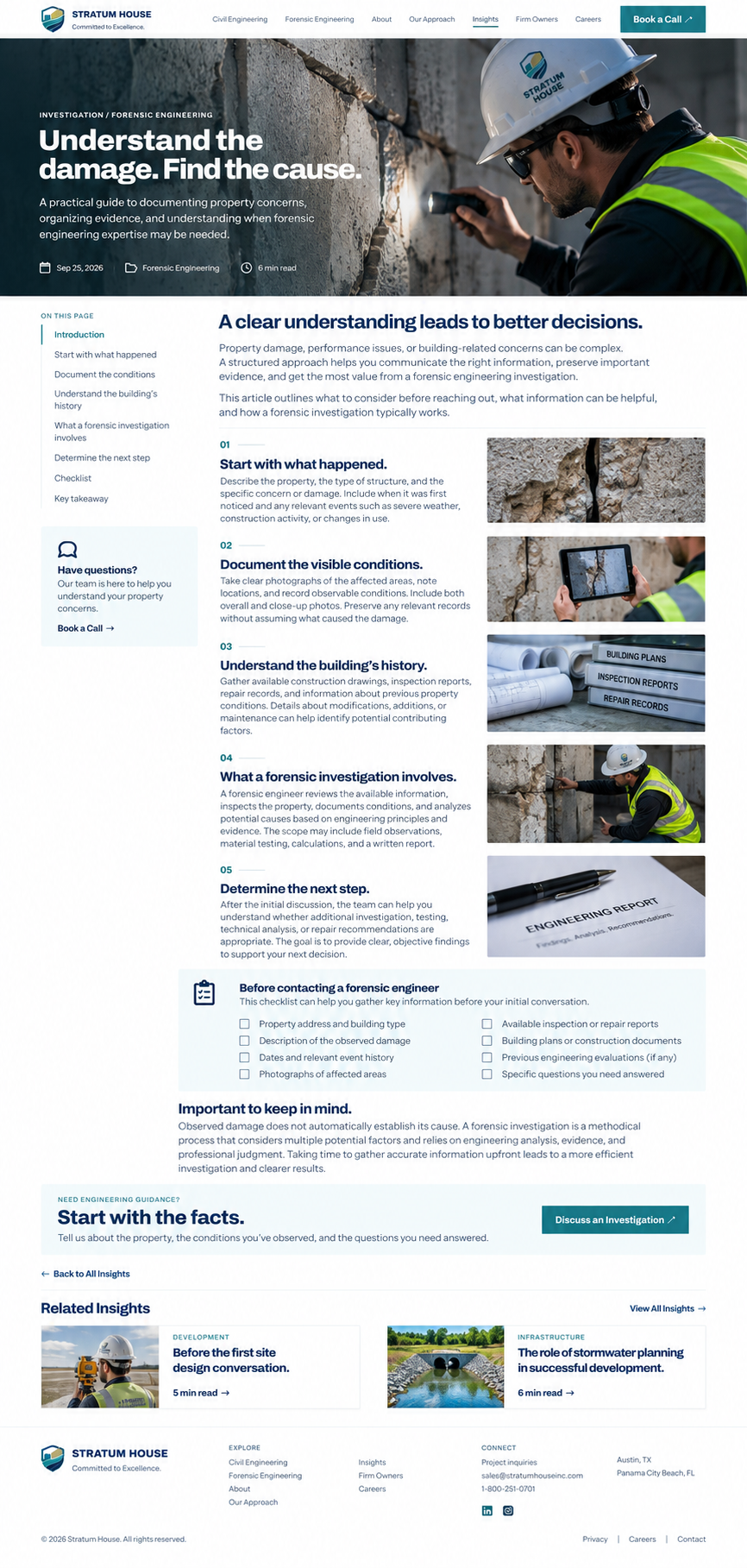
Document the visible conditions.
Take overview photographs to show the location, then closer views of the affected area. Label the room, elevation, or building element and the date. Where safe and practical, include a scale without disturbing the condition.
Keep original photographs and files, and record what you can actually see—such as cracking, staining, displacement, or corrosion—separately from what you think caused it. Avoid entering unsafe areas or removing materials to collect evidence; discuss access and any proposed sampling with the investigation team.
Understand the building’s history.
Gather available drawings, construction documents, prior inspection reports, repair records, and photographs showing earlier conditions. Include known additions, alterations, water intrusion, changes in loading, and maintenance history where relevant.
Note the source and date of each record. Plans may not reflect what was ultimately built, and a previous repair does not necessarily identify the original cause. Missing records are useful to flag during scoping.
What a forensic investigation involves.
A forensic engineer applies engineering principles to a failure or performance concern. Depending on the agreed scope, the work may include reviewing records, inspecting accessible conditions, documenting measurements, and evaluating possible explanations against the available evidence.
Some questions require calculations, material testing, monitoring, or specialist input. The engineer should explain access limitations, assumptions, and unresolved questions. Not every investigation requires destructive testing, and additional work should be agreed before it proceeds.
Determine the next step.
Use the initial conversation to identify the questions to be answered and the information needed. Ask whether the next step is a site visit, records review, additional testing, technical analysis, or coordination with another specialist.
Confirm the intended deliverable and its purpose. A findings report, repair recommendations, and detailed repair design are different scopes. Findings should communicate what the evidence supports, the limits of the investigation, and what remains uncertain.
Before contacting a forensic engineer
Gather what you have. Note what is missing so the team can discuss it.
Use this checklist while reading. Selections are not saved or submitted.Important to keep in mind.
Observed damage does not automatically establish its cause. Similar visible conditions can have different explanations, and several factors may contribute. A forensic investigation considers evidence, engineering analysis, and professional judgment to evaluate those possibilities—not simply the appearance of a crack or the timing of an event.
Useful starting points
Use these resources for preliminary context; confirm site-specific information with the relevant professionals and agencies.
ASCE Forensic Engineering Division ↗
An overview of forensic engineering and its application to failures and performance problems.
NIST Disaster and Failure Studies Repository ↗
Examples of photographs, records, and research data preserved for major investigations. The scope of an individual property investigation will differ.